
Why is the rupee falling? The economics behind the falling rupee.
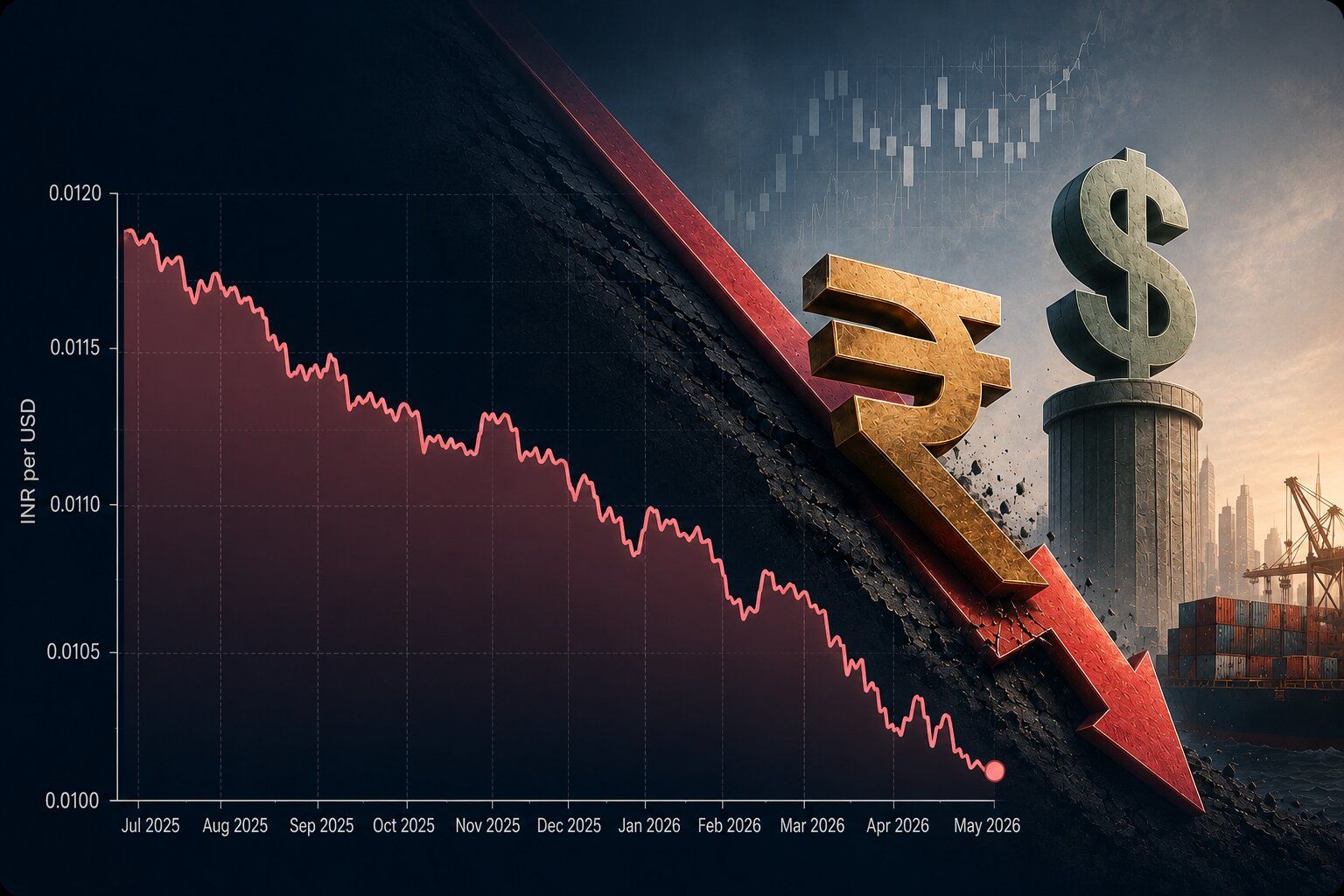
The closure of the Strait of Hormuz in the aftermath of the United States' attack on Iran has led to a massive disruption in the world economy as it is a crucial trade route with the middle east for oil and natural gas. As of 2025, around 25 per cent of the world's sea borne oil trade and 19 per cent of the global Liquified Natural Gas (LNG) trade passed through the Strait of Hormuz1 and this closure is shooting the price of crude upwards in the short term and causing energy shortages. The monthly closing price of Brent crude oil shot up from $71.32 in February 2026 to $126.69 in March 20262, and experts predict that the price of crude might cross $200 / barrel3.
For India, which is the third largest oil importer and consumer in the world, this rise in international crude prices has put upward pressure on the domestic prices of oil, threatening an inflation in the economy. The Indian government was keeping the prices of petrol and diesel stable in the economy until the 14th of May after which there was a hike in both by over 3 percent. Ever since, the oil prices have been hiked for the fourth time on the 25th of May 20264, i.e. within a span of 11 days. This is accompanied by a sharp fall in the value of rupee which further increases the effective price of oil for India, aggravating the inflationary pressures. In this article we explore the mechanism through which the value of rupee with respect to the dollar is determined and the effects of a rise in crude prices and flow-out of foreign investments in this value.
How is the value of currency determined?
India has followed a managed floating exchange rate system since 1993-94. It implies that the exchange rate is largely determined by demand and supply of currencies in the international market, while the Reserve Bank of India intervenes occasionally to reduce excessive volatility in the foreign exchange market. For example, the exchange rate between the Indian rupees and US dollar tells us the amount of rupees required to buy a dollar. When more rupees are needed to buy the same amount of dollars, we say that the value of rupees has declined/depreciated. The exchange rate between the Indian rupees and US dollar increased from 89.94 on 1st January 2026 to 91.01 on 27th February 2026 and further to 95.70 on 23rd May 2026. While the decline in rupee began prior to the war, its decline has accelerated afterwards.
Economic theory tells us that when there's an increase in demand for a commodity with supply remaining unchanged, it leads to an increase in the price of that commodity and vice-versa. The same holds for dollars. When there's a rise in demand for dollars, supply remaining unchanged, the price of dollar (in terms of rupees) rises. Such a rise in the price for dollars in terms of rupees, is called depreciation of the Indian rupee. Similarly, if there occurs a fall in the price of dollars in terms of rupees, we call it appreciation of the Indian rupee.
The demand for dollars depends on the demand for imports and the demand for forex for investing abroad — in the form of FDI (Foreign Direct Investment) and FII (Foreign Institutional Investment) — flowing out of India. The supply of dollars would depend on the demand for Indian exports and the inflow of forex, through inflow of FDI and FII to India. While imports and exports of goods and services form a part of the current account, FDI and FII are part of the capital account. There are two changes happening in the demand and supply chain.
The first change in happening in the current account. Components of the current account include imports and exports of goods and services and transfers like gifts, remittances etc. The closure of the Strait of Hormuz led to a sharp decline in the supply of crudes and shot up their international prices. Although import of crude has fallen slightly by 4.3% in April 2026 (compared to April 2025), the import bill of crudes has increased by 50 percentage5. Even after lower imports of crude oil, India needs more dollars. Thus, the dollars required to buy crude from the international market have increased from D1 to D2 (Figure 1).
Figure 1: An increase in the price of dollar caused by rise in demand and fall in supply of dollars6
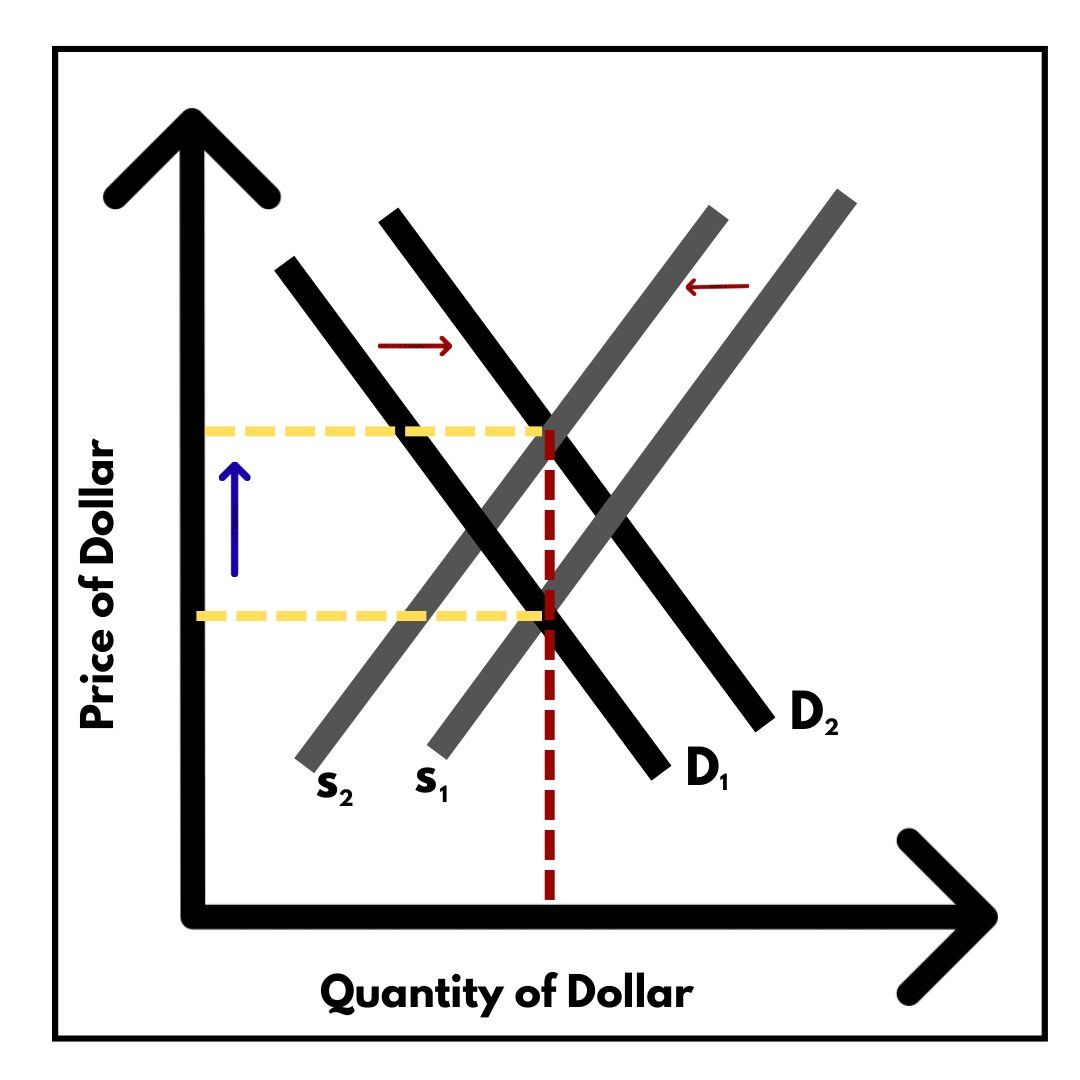
The second change is happening in the capital account, which records transactions in the financial market. Since the capital account consists of investment in the form of FDI and FII, it is much more volatile driven by speculations of investors (domestic and foreign). An investor would invest in any particular asset if the expected return on that investment (domestic/foreign) is more than on other forms of investment and more than the liquidity premium of money. With institutional investment it becomes possible to buy and sell any assets across the borders within the fractions of a few seconds. Hence finance keeps on moving, coming from one stock in one country to another stock in another country to maximise the returns. If a foreign investor invests money in the Indian economy, the supply of dollar increases in the Indian economy and vice-versa. In recent times, there has been an outflow of foreign institutional investment from India driven by speculations7. This has led to a fall in the supply of dollars from S1 to S2 (Figure 1) available to India.
This combination of a fall in supply and a rise in demand for dollars has increased the exchange rate, putting downward pressure on the rupee.
Bibliography
- Menon, R. (2026, January 28). Should the rupee be left to depreciate. The Hindu. Link
- Patnaik, P. (2026, March 28). Anatomy of rupee’s fall. NewsClick.
- Patnaik, P. (2026, March 30). The falling rupee. MR Online.
- Patnaik, P. (2026, May 23). Neo-liberal chickens are coming home to roost. NewsClick.
Footnotes
1 International Energy Agency. Strait of Hormuz. https://www.iea.org/about/oil-security-and-emergency-response/strait-of-hormuz.
2 MacroTrends. Brent Crude Oil Prices. https://www.macrotrends.net/2480/brent-crude-oil-prices-10-year-daily-chart
3 The Economic Times (2026, May 24). India can't escape global oil shock; fuel prices hurting economy. https://economictimes.indiatimes.com/industry/energy/oil-gas/india-cant-escape-global-oil-shock-fuel-prices-hurting-economy-says-former-bpcl-exec/articleshow/131292025.cms
4 Ghosh, S. (2026, May 25). Petrol, diesel prices hiked for fourth time in ten days. The Hindu
5 Ghosh, S. (2026, May 20). India imported 4.3% less crude oil in April this year. The Hindu
6 The quantity can settle anywhere depending on relative movements of demand and supply, but price will rise.
7 Moreover, the central banks are already dreading inflationary pressure, and hence in such situations, it cannot raise interest rates to attract foreign investments. This leads to a further rise in the price of dollars in terms of rupee or a fall in the value of rupee (depreciation).